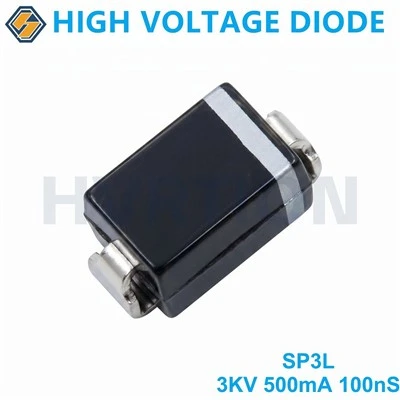
As a supplier of 350mA Fast Recovery HV Diodes, I often encounter inquiries about various technical specifications, and one of the most frequently asked questions is about the thermal resistance of these diodes. In this blog post, I will delve into the concept of thermal resistance, explain its significance for 350mA Fast Recovery HV Diodes, and provide insights into how it affects the performance and reliability of these components. 350mA Fast Recovery HV Diode
Understanding Thermal Resistance
Thermal resistance is a crucial parameter in the field of electronics, especially for semiconductor devices like diodes. It measures the resistance to heat flow between two points in a material or a device. In the context of a diode, thermal resistance is typically denoted as θ (theta) and is defined as the temperature difference between the junction (the active part of the diode where the p – n junction exists) and the ambient environment per unit of power dissipated in the device.
Mathematically, thermal resistance is expressed as:
θ = (Tj – Ta) / Pd
where:
- θ is the thermal resistance in degrees Celsius per watt (°C/W)
- Tj is the junction temperature in degrees Celsius (°C)
- Ta is the ambient temperature in degrees Celsius (°C)
- Pd is the power dissipated in the diode in watts (W)
The unit of thermal resistance, °C/W, indicates how many degrees Celsius the junction temperature will increase for every watt of power dissipated in the device. A lower thermal resistance means that the diode can dissipate heat more efficiently, resulting in a lower junction temperature for a given power dissipation.
Significance of Thermal Resistance for 350mA Fast Recovery HV Diodes
350mA Fast Recovery HV Diodes are designed to handle high – voltage applications and have fast recovery times, which are essential for applications such as switching power supplies, inverters, and high – frequency circuits. In these applications, the diodes are subjected to significant power dissipation due to the high voltage and current levels.
The junction temperature of a diode is a critical factor that affects its performance and reliability. As the junction temperature increases, the forward voltage drop of the diode decreases, and the reverse leakage current increases. These changes can lead to reduced efficiency, increased power consumption, and even device failure if the junction temperature exceeds the maximum allowable limit specified by the manufacturer.
Thermal resistance plays a vital role in controlling the junction temperature of 350mA Fast Recovery HV Diodes. By minimizing the thermal resistance, we can ensure that the diode operates at a safe junction temperature, thereby improving its performance and extending its lifespan.
Factors Affecting the Thermal Resistance of 350mA Fast Recovery HV Diodes
Several factors can influence the thermal resistance of 350mA Fast Recovery HV Diodes:
Package Design
The package of a diode serves as the interface between the semiconductor die and the external environment. Different package designs have different thermal characteristics. For example, a surface – mount package may have a higher thermal resistance compared to a through – hole package because the surface – mount package has a smaller contact area with the PCB, which reduces the heat transfer efficiency.
Heat Sinking
Heat sinking is a common technique used to reduce the thermal resistance of electronic components. By attaching a heat sink to the diode, we can increase the surface area available for heat dissipation, thereby improving the heat transfer from the diode to the ambient environment. The effectiveness of heat sinking depends on the size, material, and design of the heat sink.
PCB Layout
The layout of the printed circuit board (PCB) can also affect the thermal resistance of the diode. A well – designed PCB with proper copper traces and thermal vias can provide a low – resistance path for heat transfer, reducing the junction temperature of the diode. On the other hand, a poorly designed PCB with insufficient copper area or improper thermal vias can increase the thermal resistance and lead to higher junction temperatures.
Ambient Conditions
The ambient temperature and airflow around the diode can significantly impact its thermal resistance. In a high – temperature environment or with limited airflow, the heat dissipation from the diode will be less efficient, resulting in a higher junction temperature. Therefore, it is important to consider the ambient conditions when using 350mA Fast Recovery HV Diodes.
Measuring the Thermal Resistance of 350mA Fast Recovery HV Diodes
Measuring the thermal resistance of a diode requires specialized equipment and techniques. One common method is the transient thermal testing, which involves applying a known power pulse to the diode and measuring the temperature response over time. By analyzing the temperature transient, we can determine the thermal resistance of the diode.
Another method is the steady – state thermal testing, where the diode is operated at a constant power level until it reaches a steady – state temperature. The junction temperature can be measured using a thermocouple or an infrared thermometer, and the power dissipation can be calculated from the voltage and current measurements. The thermal resistance can then be calculated using the formula mentioned earlier.
Importance of Accurate Thermal Resistance Data
Accurate thermal resistance data is essential for the proper design and application of 350mA Fast Recovery HV Diodes. Design engineers rely on this data to calculate the junction temperature of the diode under different operating conditions and to determine the appropriate heat sinking requirements. If the thermal resistance data is inaccurate, it can lead to over – or under – estimation of the junction temperature, resulting in either unnecessary heat sinking or device failure due to overheating.
As a supplier, we ensure that our 350mA Fast Recovery HV Diodes are thoroughly tested to provide accurate thermal resistance data. We also offer technical support to help our customers select the right diodes for their applications and to assist them in designing effective thermal management solutions.
Impact of Thermal Resistance on Diode Performance
The thermal resistance of a 350mA Fast Recovery HV Diode has a direct impact on its performance in several ways:
Forward Voltage Drop
As the junction temperature increases due to a high thermal resistance, the forward voltage drop of the diode decreases. This can affect the efficiency of power conversion circuits, as a lower forward voltage drop may result in less power loss in the diode. However, if the forward voltage drop becomes too low, it can also lead to issues such as current sharing problems in parallel – connected diodes.
Reverse Leakage Current
The reverse leakage current of a diode increases with the junction temperature. A high thermal resistance can cause the junction temperature to rise, resulting in an increased reverse leakage current. This can lead to increased power consumption and reduced performance, especially in high – voltage applications where the reverse leakage current can be a significant factor.
Switching Speed
The switching speed of a fast – recovery diode can also be affected by the junction temperature. As the junction temperature increases, the charge stored in the diode’s p – n junction takes longer to dissipate, which can slow down the switching speed. A high thermal resistance can exacerbate this effect, reducing the diode’s ability to operate at high frequencies.
Thermal Management Strategies for 350mA Fast Recovery HV Diodes
To ensure the reliable operation of 350mA Fast Recovery HV Diodes, it is important to implement effective thermal management strategies. Here are some common strategies:
Selecting the Right Package
Choose a diode package with a low thermal resistance. Through – hole packages generally offer better thermal performance compared to surface – mount packages due to their larger contact area with the PCB. However, surface – mount packages are more suitable for applications where space is limited.
Using Heat Sinks
Attach a heat sink to the diode to increase the surface area available for heat dissipation. Heat sinks can be made of materials such as aluminum or copper, which have high thermal conductivity. The size and shape of the heat sink should be selected based on the power dissipation of the diode and the ambient conditions.
Optimizing PCB Layout
Design the PCB layout to provide a low – resistance path for heat transfer. Use wide copper traces and thermal vias to conduct heat away from the diode. Place the diode in an area with good airflow to enhance natural convection.
Forced Air Cooling
In applications where natural convection is insufficient, forced air cooling can be used. This can be achieved by using fans or blowers to increase the airflow around the diode and the heat sink.
Conclusion
The thermal resistance of a 350mA Fast Recovery HV Diode is a critical parameter that affects its performance, reliability, and lifespan. By understanding the concept of thermal resistance, the factors that influence it, and the importance of accurate thermal resistance data, design engineers can make informed decisions when selecting and using these diodes in their applications.
Laser Power Supply As a supplier of 350mA Fast Recovery HV Diodes, we are committed to providing high – quality products with accurate thermal resistance data and excellent technical support. If you are interested in purchasing our diodes or need more information about thermal management for your specific application, please feel free to contact us for further discussions and procurement negotiations.
References
- "Semiconductor Device Physics" by Donald A. Neamen
- "Power Electronics: Circuits, Devices and Applications" by Muhammad H. Rashid
- Technical datasheets of various 350mA Fast Recovery HV Diodes
Anshan HVRTION Electronic Technology Co., Ltd.
As one of the most professional 350ma fast recovery hv diode manufacturers and suppliers in China, we’re featured by quality products and good price. Please rest assured to buy discount 350ma fast recovery hv diode for sale here and get quotation from our factory. We also accept customized orders.
Address: 17 East Jiefang RD., Tiedong District, Anshan, Liaoning, China.
E-mail: hvrtion@hotmail.com
WebSite: https://www.hvrtion.com/
